Atmospheric pressure · 気圧

The air has weight.
Some days, you feel it.

About ten tonnes of air press on every square metre of Japan. When a low or a typhoon moves in, that weight falls — and plenty of people notice it in their head before they see a cloud.

1013hPa

Move up and down the sky to change the weather.
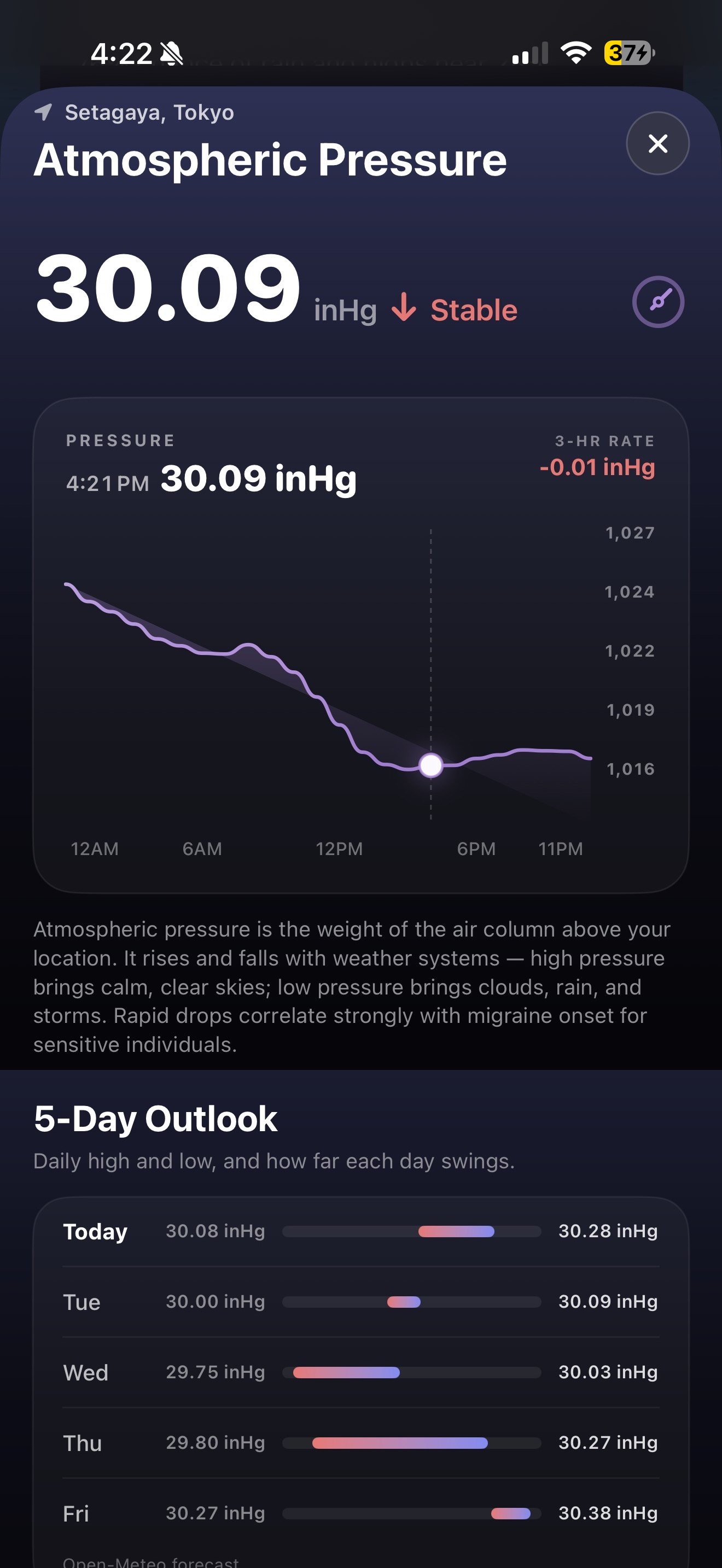
SHINDO's Atmospheric Pressure screen for Setagaya, Tokyo: 30.09 inHg, the day's pressure chart, and a 5-day outlook of daily highs and lows.
Moved here and started getting headaches?

You're not imagining it, and you're not alone. Japanese even has words for it: 気象病 (kishōbyō, “weather sickness”) and 天気痛 (tenkitsū, “weather pain”). Plenty of people here say their head knows rain is coming before the forecast does. Many people arriving from abroad have never heard of it — so the headaches that start in their first rainy season or their first typhoon get blamed on jet lag, stress or the new job.

How big is a pressure drop?

Ride the weather up a tower.

Near sea level, air pressure falls by about 1 hPa for every 8 metres you climb. So a change in the weather can be measured in floors.

  1. 1013 hPaGround floor. The standard atmosphere at sea level.
  2. −6 to −10 hPaAbout 50–80 m up — a 15- to 25-storey building. In a 2015 study of migraine patients in Japan, falls of this size below 1013 hPa were the ones most often linked to attacks.
  3. −40 hPaAbout 330 m — roughly the height of Tokyo Tower. A strong typhoon passing close by can take a city here in a matter of hours.
  4. 907.3 hPaAbout 920 m. The lowest pressure ever observed in Japan, on Okinoerabu Island during a 1977 typhoon.

A lift does it in a minute and your ears pop. Weather does it over hours — too slowly to notice, but not too slowly for some bodies.

A typhoon, on paper

Watch the barograph draw the V.

Weather stations used to keep a barograph: a pen resting on a slowly turning drum, drawing pressure as a line. When a typhoon passes, the line draws a V — a long slide down, the bottom as the storm comes closest, then a steep climb back. Scroll to send one past Tokyo.

—1010hPa · Tokyo

An illustrative typhoon on an illustrative track — not a real storm. Rings are isobars, lines of equal pressure, every 8 hPa.

Why your head might know

A barometer in your inner ear?

  1. Pressure falls. It reaches you everywhere at once — no draft, no sound, nothing to see.
  2. Researchers in Japan think the inner ear, which also runs your sense of balance, may pick it up. In a 2019 study, lowering the air pressure by 40 hPa switched on neurons in the balance centre of mice.
  3. Your balance system then reports something your eyes don't see. One explanation is that this mismatch puts the nervous system on edge.
  4. For some people it ends as a headache, dizziness, aching joints or heavy sleepiness. Not for everyone — and the science is still young.
Your first year in Japan

When did you arrive?

Japan's pressure has seasons, and each one has its own rhythm. Pick the month you arrived — or will — and see what your first twelve months bring.

Illustrative: how unsettled pressure tends to be in each season around Tokyo. Not measured data; timing varies by year and region.

SHINDO pressure

Know the drop before it arrives.

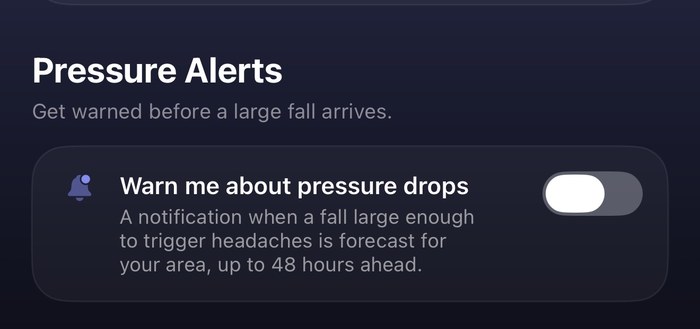
SHINDO charts the pressure where you are, shows five days ahead and explains the pattern in plain language. Turn on Pressure Alerts and it warns you when a large fall is forecast for your area, up to 48 hours ahead.

✦ Example explanation

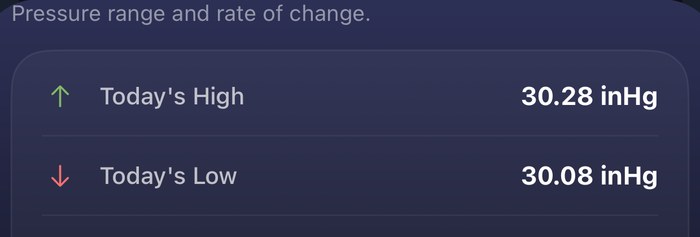
Today's pressure: high 30.28 inHg, low 30.08 inHg, range 0.20 inHg, 3-hour rate −0.01 inHg.
Pressure Alerts: warn me about pressure drops, up to 48 hours ahead.
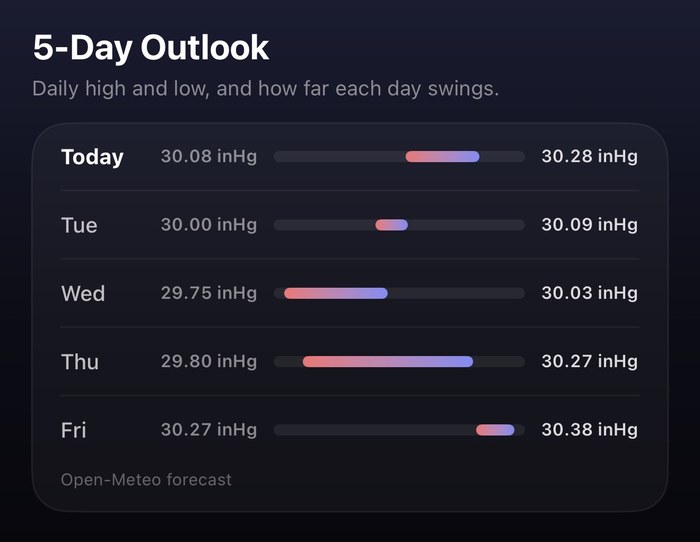
SHINDO's 5-day pressure outlook: daily high and low, and how far each day swings.
hPa · inHg · mmHg

One pressure, three numbers.

Japanese TV and the Japan Meteorological Agency use hectopascals (hPa). Apps set to US units show inches of mercury — like the SHINDO screens on this page. The oldest barometers measured it in millimetres of mercury. Drag the mercury to see how they line up.

hPa
1013
inHg
29.92
mmHg
760
Altitude equivalent
0 m

Air pushes on the dish; the dish pushes mercury up the tube. 760 mm at the standard atmosphere.

A month of notesPressure Headache
What helps

Patterns show up on paper.

Headache diaries are a standard tool: note each headache, and put the weather next to it. If yours follow falls in pressure, it usually shows within a month or two — and you'll have something useful to show a doctor.

Your head knew first. Now your phone does too.

Get SHINDO first.

Get the app
QR code linking to the SHINDO download page

SHINDO shows pressure information. It does not diagnose, predict or treat headaches or any other medical condition. If you have frequent, severe or unusual headaches, see a doctor.

Research mentioned: a 2015 study of 34 migraine patients in Japan (SpringerPlus) and a 2019 study in mice (PLoS ONE). The lowest observed pressure is from Japan Meteorological Agency records. Altitude equivalents use the international standard atmosphere.

Pressure forecasts in the app come from Open-Meteo. Screens show the SHINDO app on 19 October 2026; the sky, typhoon, year ring, forecast curve and diary on this page are illustrations.